(a)Applicability.
The provisions of this section and 1040.11, as amended, are applicable
as specified to all laser products manufactured or assembled after
August 1, 1976, except when:
(1) Such
a laser product is either sold to a manufacturer of an electronic
product for use as a component (or replacement) in such electronic
product, or
(2) Sold by or for a
manufacturer of an electronic product for use as a component (or
replacement) in such electronic product, provided that such laser
product:
(i) Is accompanied by a
general warning notice that adequate instructions for the safe
installation of the laser product are provided in servicing information
available from the complete laser product manufacturer under paragraph
(h)(2)(ii) of this section, and should be followed,
(ii)
Is labeled with a statement that it is designated for use solely as a
component of such electronic product and therefore does not comply with
the appropriate requirements of this section and 1040.11 for complete
laser products, and
(iii) Is not a removable laser system as described in paragraph (c)(2) of this section; and
(3) The manufacturer of such a laser product, if manufactured after August 20, 1986:
(i)
Registers, and provides a listing by type of such laser products
manufactured that includes the product name, model number and laser
medium or emitted wavelength(s), and the name and address of the
manufacturer. The manufacturer must submit the registration and listing
to the Director, Office of Compliance (HFZ-300), Center for Devices and
Radiological Health, 2094 Gaither Rd., Rockville, MD 20850.
(ii)
Maintains and allows access to any sales, shipping, or distribution
records that identify the purchaser of such a laser product by name and
address, the product by type, the number of units sold, and the date of
sale (shipment). These records shall be maintained and made available
as specified in 1002.31.
(b)Definitions. As used in this section and 1040.11, the following definitions apply:
(1)Accessible emission level
means the magnitude of accessible laser or collateral radiation of a
specific wavelength and emission duration at a particular point as
measured according to paragraph (e) of this section. Accessible laser
or collateral radiation is radiation to which human access is possible,
as defined in paragraphs (b) (12), (15), and (22) of this section.
(2)Accessible emission limit
means the maximum accessible emission level permitted within a
particular class as set forth in paragraphs (c), (d), and (e) of this
section.
(3)Aperture means
any opening in the protective housing or other enclosure of a laser
product through which laser or collateral radiation is emitted, thereby
allowing human access to such radiation.
(4)Aperture stop means an opening serving to limit the size and to define the shape of the area over which radiation is measured.
(5)Class I laser product
means any laser product that does not permit access during the
operation to levels of laser radiation in excess of the accessible
emission limits contained in table I of paragraph (d) of this section.1
(6)Class IIa laser product
means any laser product that permits human access during operation to
levels of visible laser radiation in excess of the accessible emission
limits contained in table I, but does not permit human access during
operation to levels of laser radiation in excess of the accessible
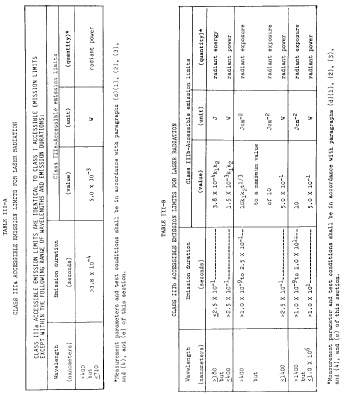
emission limits contained in table II-A of paragraph (d) of this
section.2
(7)Class II laser product
means any laser product that permits human access during operation to
levels of visible laser radiation in excess of the accessible emission
limits contained in table II-A, but does not permit human access during
operation to levels of laser radiation in excess of the accessible
emission limits contained in table II of paragraph (d) of this section.3
(8)Class IIIa laser product
means any laser product that permits human access during operation to
levels of visible laser radiation in excess of the accessible emission
limits contained in table II, but does not permit human access during
operation to levels of laser radiation in excess of the accessible
emission limits contained in table III-A of paragraph (d) of this
section.4
(9)Class IIIb laser product
means any laser product that permits human access during operation to
levels of laser radiation in excess of the accessible emission limits
of table III-A, but does not permit human access during operation to
levels of laser radiation in excess of the accessible emission limits
contained in table III-B of paragraph (d) of this section.5
(10)Class III laser product means any Class IIIa or Class IIIb laser product.
(11)Class IV laser product
means any laser that permits human access during operation to levels of
laser radiation in excess of the accessible emission limits contained
in table III-B of paragraph (d) of this section.6
(12)Collateral radiation
means any electronic product radiation, except laser radiation, emitted
by a laser product as a result of the operation of the laser(s) or any
component of the laser product that is physically necessary for the
operation of the laser(s).
(13)Demonstration laser product
means any laser product manufactured, designed, intended, or promoted
for purposes of demonstration, entertainment, advertising display, or
artistic composition. The term "demonstration laser product" does not
apply to laser products which are not manufactured, designed, intended,
or promoted for such purposes, even though they may be used for those
purposes or are intended to demonstrate other applications.
(14)Emission duration
means the temporal duration of a pulse, a series of pulses, or
continuous operation, expressed in seconds, during which human access
to laser or collateral radiation could be permitted as a result of
operation, maintenance, or service of a laser product.
(15)Human access
means the capacity to intercept laser or collateral radiation by any
part of the human body. For laser products that contain Class IIIb or
IV levels of laser radiation, "human access" also means access to laser
radiation that can be reflected directly by any single introduced flat
surface from the interior of the product through any opening in the
protective housing of the product.
(16)Integrated radiance
means radiant energy per unit area of a radiating surface per unit
solid angle of emission, expressed in joules per square centimeter per
steradian (Jcm-2sr-1).
(17)Invisible radiation
means laser or collateral radiation having wavelengths of equal to or
greater than 180 nm but less than or equal to 400 nm or greater than
710 nm but less than or equal to 1.0*106nm (1 millimeter).
(18)Irradiance
means the time-averaged radiant power incident on an element of a
surface divided by the area of that element, expressed in watts per
square centimeter (W cm-2).
(19)Laser
means any device that can be made to produce or amplify electromagnetic
radiation at wavelenghts greater than 250 nm but less than or equal to
13,000 nm or, after August 20, 1986, at wavelengths equal to or greater
than 180 nm but less than or equal to 1.0*106nm primarily by the
process of controlled stimulated emission.
(20)Laser energy source
means any device intended for use in conjunction with a laser to supply
energy for the operation of the laser. General energy sources such as
electrical supply mains or batteries shall not be considered to
constitute laser energy sources.
(21)Laser product
means any manufactured product or assemblage of components which
constitutes, incorporates, or is intended to incorporate a laser or
laser system. A laser or laser system that is intended for use as a
component of an electronic product shall itself be considered a laser
product.
(22)Laser radiation
means all electromagnetic radiation emitted by a laser product within
the spectral range specified in paragraph (b)(19) of this section that
is produced as a result of controlled stimulated emission or that is
detectable with radiation so produced through the appropriate aperture
stop and within the appropriate solid angle of acceptance, as specified
in paragraph (e) of this section.
(23)Laser system
means a laser in combination with an appropriate laser energy source
with or without additional incorporated components. See paragraph
(c)(2) of this section for an explanation of the term "removable laser
system."
(24)Maintenance
means performance of those adjustments or procedures specified in user
information provided by the manufacturer with the laser product which
are to be performed by the user for the purpose of assuring the
intended performance of the product. It does not include operation or
service as defined in paragraph (b) (27) and (38) of this section.
(25)Maximum output
means the maximum radiant power and, where applicable, the maximum
radiant energy per pulse of accessible laser radiation emitted by a
laser product during operation, as determined under paragraph (e) of
this section.
(26)Medical laser product
means any laser product which is a medical device as defined in 21
U.S.C. 321(h) and is manufactured, designed, intended or promoted for
in vivo laser irradiation of any part of the human body for the purpose
of: (i) Diagnosis, surgery, or therapy; or (ii) relative positioning of
the human body.
(27)Operation
means the performance of the laser product over the full range of its
functions. It does not include maintenance or service as defined in
paragraphs (b) (24) and (38) of this section.
(28)Protective housing
means those portions of a laser product which are designed to prevent
human access to laser or collateral radiation in excess of the
prescribed accessible emission limits under conditions specified in
this section and in 1040.11.
(29)Pulse duration means the time increment measured between the half-peak-power points at the leading and trailing edges of a pulse.
(30)Radiance
means time-averaged radiant power per unit area of a radiating surface
per unit solid angle of emission, expressed in watts per square
centimeter per steradian (W cm-2sr-1).
(31)Radiant energy means energy emitted, transferred or received in the form of radiation, expressed in joules (J).
(32)Radiant exposure
means the radiant energy incident on an element of a surface divided by
the area of the element, expressed in joules per square centimeter
(Jcm-2)
(33)Radiant power means time-averaged power emitted, transferred or received in the form of radiation, expressed in watts (W).
(34)Remote interlock connector means an electrical connector which permits the connection of external remote interlocks.
(35)Safety interlock
means a device associated with the protective housing of a laser
product to prevent human access to excessive radiation in accordance
with paragraph (f)(2) of this section.
(36)Sampling interval
means the time interval during which the level of accessible laser or
collateral radiation is sampled by a measurement process. The magnitude
of the sampling interval in units of seconds is represented by the
symbol (t ).
(37)Scanned laser radiation
means laser radiation having a time-varying direction, origin or
pattern of propagation with respect to a stationary frame of reference.
(38)Service
means the performance of those procedures or adjustments described in
the manufacturer's service instructions which may affect any aspect of
the product's performance for which this section and 1040.11 have
applicable requirements. It does not include maintenance or operation
as defined in paragraphs (b) (24) and (27) of this section.
(39)Surveying, leveling, or alignment laser product means a laser product manufactured, designed, intended or promoted for one or more of the following uses:
(i) Determining and delineating the form, extent, or position of a point, body, or area by taking angular measurement.
(ii) Positioning or adjusting parts in proper relation to one another.
(iii) Defining a plane, level, elevation, or straight line.
(40)Visible radiation means laser or collateral radiation having wavelengths of greater than 400 nm but less than or equal to 710 nm.
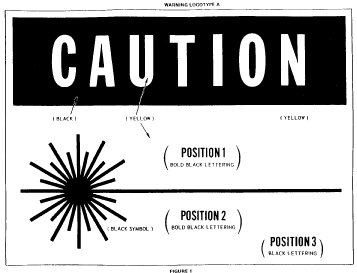
(41)Warning logotype means a logotype as illustrated in either figure 1 or figure 2 of paragraph (g) of this section.
(42)Wavelength means the propagation wavelength in air of electromagnetic radiation.
(c)Classification of laser products --(1)All laser products.
Each laser product shall be classified in Class I, IIa, II, IIIa, IIIb,
or IV in accordance with definitions set forth in paragraphs (b) (5)
through (11) of this section. The product classification shall be based
on the highest accessible emission level(s) of laser radiation to which
human access is possible during operation in accordance with paragraphs
(d), (e), and (f)(1) of this section.
(2)Removable laser systems.
Any laser system that is incorporated into a laser product subject to
the requirements of this section and that is capable, without
modification, of producing laser radiation when removed from such laser
product, shall itself be considered a laser product and shall be
separately subject to the applicable requirements in this subchapter
for laser products of its class. It shall be classified on the basis of
accessible emission of laser radiation when so removed.
(d)Accessible emission limits.
Accessible emission limits for laser radiation in each class are
specified in tables I, II-A, II, III-A, and III-B of this paragraph.
The factors,k 1andk 2vary with wavelength and
emission duration. These factors are given in table IV of this
paragraph, with selected numerical values in table V of this paragraph.
Accessible emission limits for collateral radiation are specified in
table VI of this paragraph.

View or download PDF

View or download PDF
View or download PDF

View or download PDF

View or download PDF

View or download PDF
(1)Beam of a single wavelength.
Laser or collateral radiation of a single wavelength exceeds the
accessible emission limits of a class if its accessible emission level
is greater than the accessible emission limit of that class within any
of the ranges of emission duration specified in tables I, II-A, II,
III-A, and III-B of this paragraph.
(2)Beam of multiple wavelengths in same range.
Laser or collateral radiation having two or more wavelengths within any
one of the wavelength ranges specified in tables I, II-A, II, III-A,
and III-B of this paragraph exceeds the accessible emission limits of a
class if the sum of the ratios of the accessible emission level to the
corresponding accessible emission limit at each such wavelength is
greater than unity for that combination of emission duration and
wavelength distribution which results in the maximum sum.
(3)Beam with multiple wavelengths in different ranges.
Laser or collateral radiation having wavelengths within two or more of
the wavelength ranges specified in tables I, II-A, II, III-A, and III-B
of this paragraph exceeds the accessible emission limits of a class if
it exceeds the applicable limits within any one of those wavelength
ranges. This determination is made for each wavelength range in
accordance with paragraph (d) (1) or (2) of this section.
(4)Class I dual limits.
Laser or collateral radiation in the wavelength range of greater than
400 nm but less than or equal to 1.400 nm exceeds the accessible
emission limits of Class I if it exceeds both:
(i)
The Class I accessible emission limits for radiant energy within any
range of emission duration specified in table I of this paragraph, and
(ii)
The Class I accessible emission limits for integrated radiance within
any range of emission duration specified in table I of this paragraph.
(e)Tests for determination of compliance --(1)Tests for certification.
Tests on which certification under 1010.2 is based shall account for
all errors and statistical uncertainties in the measurement process.
Because compliance with the standard is required for the useful life of
a product such tests shall also account for increases in emission and
degradation in radiation safety with age.
(2)Test conditions.
Except as provided in 1010.13, tests for compliance with each of the
applicable requirements of this section and 1040.11 shall be made
during operation, maintenance, or service as appropriate:
(i)
Under those conditions and procedures which maximize the accessible
emission levels, including start-up, stabilized emission, and shut-down
of the laser product; and
(ii) With
all controls and adjustments listed in the operation, maintenance, and
service instructions adjusted in combination to result in the maximum
accessible emission level of radiation; and
(iii)
At points in space to which human access is possible in the product
configuration which is necessary to determine compliance with each
requirement, e.g., if operation may require removal of portions of the
protective housing and defeat of safety interlocks, measurements shall
be made at points accessible in that product configuration; and
(iv)
With the measuring instrument detector so positioned and so oriented
with respect to the laser product as to result in the maximum detection
of radiation by the instrument; and
(v)
For a laser product other than a laser system, with the laser coupled
to that type of laser energy source which is specified as compatible by
the laser product manufacturer and which produces the maximum emission
level of accessible radiation from that product.
(3)Measurement parameters.
Accessible emission levels of laser and collateral radiation shall be
based upon the following measurements as appropriate, or their
equivalent:
(i) For laser products
intended to be used in a locale where the emitted laser radiation is
unlikely to be viewed with optical instruments, the radiant power (W)
or radiant energy (J) detectable through a circular aperture stop
having a diameter of 7 millimeters and within a circular solid angle of
acceptance of 1*10-3steradian with collimating optics of 5 diopters or
less. For scanned laser radiation, the direction of the solid angle of
acceptance shall change as needed to maximize detectable radiation,
with an angular speed of up to 5 radians/second. A 50 millimeter
diameter aperture stop with the same collimating optics and acceptance
angle stated above shall be used for all other laser products (except
that a 7 millimeter diameter aperture stop shall be used in the
measurement of scanned laser radiation emitted by laser products
manufactured on or before August 20, 1986.
(ii)
The irradiance (W cm-2) or radiant exposure (J cm-2equivalent to the
radiant power (W) or radiant energy (J) detectable through a circular
aperture stop having a diameter of 7 millimeters and, for irradiance,
within a circular solid angle of acceptance of 1**10-3steradian with
collimating optics of 5 diopters or less, divided by the area of the
aperture stop (cm-2).
(iii) The
radiance (W cm-2sr-1) or integrated radiance (J cm-2sr-1) equivalent to
the radiant power (W) or radiant energy (J) detectable through a
circular aperture stop having a diameter of 7 millimeters and within a
circular solid angle of acceptance of 1*10-5steradian with collimating
optics of 5 diopters or less, divided by that solid angle (sr) and by
the area of the aperture stop (cm-2).
(f)Performance requirements --(1)Protective housing.
Each laser product shall have a protective housing that prevents human
access during operation to laser and collateral radiation that exceed
the limits of Class I and table VI, respectively, wherever and whenever
such human access is not necessary for the product to perform its
intended function. Wherever and whenever human access to laser
radiation levels that exceed the limits of Class I is necessary, these
levels shall not exceed the limits of the lowest class necessary to
perform the intended function(s) of the product.
(2)Safety interlocks.
(i) Each laser product, regardless of its class, shall be provided with
at least one safety interlock for each portion of the protective
housing which is designed to be removed or displaced during operation
or maintenance, if removal or displacement of the protective housing
could permit, in the absence of such interlock(s), human access to
laser or collateral radiation in excess of the accessible emission
limit applicable under paragraph (f)(1) of this section.
(ii)
Each required safety interlock, unless defeated, shall prevent such
human access to laser and collateral radiation upon removal or
displacement of such portion of the protective housing
(iii)
Either multiple safety interlocks or a means to preclude removal or
displacement of the interlocked portion of the protective housing shall
be provided, if failure of a single interlock would allow;
(a ) Human access to a level of laser radiation in excess of the accessible emission limits of Class IIIa; or
(b
) Laser radiation in excess of the accessible emission limits of Class
II to be emitted directly through the opening created by removal or
displacement of the interlocked portion of the protective housing.
(iv)
Laser products that incorporate safety interlocks designed to allow
safety interlock defeat shall incorporate a means of visual or aural
indication of interlock defeat. During interlock defeat, such
indication shall be visible or audible whenever the laser product is
energized, with and without the associated portion of the protective
housing removed or displaced.
(v)
Replacement of a removed or displaced portion of the protective housing
shall not be possible while required safety interlocks are defeated.
(3)Remote interlock connector.
Each laser system classified as a Class IIIb or IV laser product shall
incorporate a readily available remote interlock connector having an
electrical potential difference of no greater than 130 root-mean-square
volts between terminals. When the terminals of the connector are not
electrically joined, human access to all laser and collateral radiation
from the laser product in excess of the accessible emission limits of
Class I and table VI shall be prevented.
(4)Key control.
Each laser system classified as a Class IIIb or IV laser product shall
incorporate a key-actuated master control. The key shall be removable
and the laser shall not be operable when the key is removed.
(5)Laser radiation emission indicator.
(i) Each laser system classified as a Class II or IIIa laser product
shall incorporate an emission indicator that provides a visible or
audible signal during emission of accessible laser radiation in excess
of the accessible emission limits of Class I.
(ii)
Each laser system classified as a Class IIIb or IV laser product shall
incorporate an emission indicator which provides a visible or audible
signal during emission of accessible laser radiation in excess of the
accessible emission limits of Class I, and sufficiently prior to
emission of such radiation to allow appropriate action to avoid
exposure to the laser radiation.
(iii)
For laser systems manufactured on or before August 20, 1986, if the
laser and laser energy source are housed separately and can be operated
at a separation distance of greater than 2 meters, both laser and laser
energy source shall incorporate an emission indicator as required in
accordance with paragraph (f)(5) (i) or (ii) of this section. For laser
systems manufactured after August 20, 1986, each separately housed
laser and operation control of a laser system that regulates the laser
or collateral radiation emitted by a product during operation shall
incorporate an emission indicator as required in accordance with
paragraph (f)(5) (i) or (ii) of this section, if the laser or operation
control can be operated at a separation distance greater than 2 meters
from any other separately housed portion of the laser product
incorporating an emission indicator.
(iv)
Any visible signal required by paragraph (f)(5) (i) or (ii) of this
section shall be clearly visible through protective eyewear designed
specifically for the wavelength(s) of the emitted laser radiation.
(v)
Emission indicators required by paragraph (f)(5) (i) or (ii) of this
section shall be located so that viewing does not require human
exposure to laser or collateral radiation in excess of the accessible
emission limits of Class I and table VI.
(6)Beam attenuator.
(i) Each laser system classified as a Class II, III, or IV laser
product shall be provided with one or more permanently attached means,
other than laser energy source switch(es), electrical supply main
connectors, or the key-actuated master control, capable of preventing
access by any part of the human body to all laser and collateral
radiation in excess of the accessible emission limits of Class I and
table VI.
(ii) If the configuration,
design, or function of the laser product would make unnecessary
compliance with the requirement in paragraph (f)(6)(i) of this section,
the Director, Office of Compliance (HFZ-300), Center for Devices and
Radiological Health, may, upon written application by the manufacturer,
approve alternate means to accomplish the radiation protection provided
by the beam attenuator.
(7)Location of controls.
Each Class IIa, II, III, or IV laser product shall have operational and
adjustment controls located so that human exposure to laser or
collateral radiation in excess of the accessible emission limits of
Class I and table VI is unnecessary for operation or adjustment of such
controls.
(8)Viewing optics.
All viewing optics, viewports, and display screens incorporated into a
laser product, regardless of its class, shall limit the levels of laser
and collateral radiation accessible to the human eye by means of such
viewing optics, viewports, or display screens during operation or
maintenance to less than the accessible emission limits of Class I and
table VI. For any shutter or variable attenuator incorporated into such
viewing optics, viewports, or display screens, a means shall be
provided:
(i) To prevent access by
the human eye to laser and collateral radiation in excess of the
accessible emission limits of Class I and table VI whenever the shutter
is opened or the attenuator varied.
(ii)
To preclude, upon failure of such means as required in paragraph
(f)(8)(i) of this section, opening the shutter or varying the
attenuator when access by the human eye is possible to laser or
collateral radiation in excess of the accessible emission limits of
Class I and table VI.
(9)Scanning safeguard.
Laser products that emit accessible scanned laser radiation shall not,
as a result of any failure causing a change in either scan velocity or
amplitude, permit human access to laser radiation in excess of:
(i) The accessible emission limits of the class of the product, or
(ii)
The accessible emission limits of the class of the scanned laser
radiation if the product is Class IIIb or IV and the accessible
emission limits of Class IIIa would be exceeded solely as result of
such failure.
(10)Manual reset mechanism.
Each laser system manufactured after August 20, 1986, and classified as
a Class IV laser product shall be provided with a manual reset to
enable resumption of laser radiation emission after interruption of
emission caused by the use of a remote interlock or after an
interruption of emission in excess of 5 seconds duration due to the
unexpected loss of main electrical power.
(g)Labeling requirements.
In addition to the requirements of 1010.2 and 1010.3, each laser
product shall be subject to the applicable labeling requirements of
this paragraph.
(1)Class IIa and II designations and warnings.
(i) Each Class IIa laser product shall have affixed a label bearing the
following wording: "Class IIa Laser Product--Avoid Long-Term Viewing of
Direct Laser Radiation."
(ii) Each
Class II laser product shall have affixed a label bearing the warning
logotype A (figure 1 in this paragraph) and including the following
wording:
[Position I on the logotype]
"LASER RADIATION--DO NOT STARE INTO BEAM"; and
[Position 3 on the logotype]
"CLASS II LASER PRODUCT".
View or download PDF
(2)Class IIIa and IIIb designations and warnings.
(i) Each Class IIIa laser product with an irradiance less than or equal
to 2.5*10-3W cm2-shall have affixed a label bearing the warning
logotype A (figure 1 of paragraph (g)(1)(ii) of this section) and
including the following wording:
[Position 1 on the logotype]
"LASER RADIATION--DO NOT STARE INTO BEAM OR VIEW DIRECTLY WITH OPTICAL INSTRUMENTS"; and,
[Position 3 on the logotype]
"CLASS IIIa LASER PRODUCT".
(ii)
Each Class IIIa laser product with an irradiance greater than 2.5*10-3W
cm-2shall have affixed a label bearing the warning logotype B (figure 2
in this paragraph) and including the following wording:
[Position 1 on the logotype]
"LASER RADIATION--AVOID DIRECT EYE EXPOSURE"; and,
[Position 3 on the logotype]
"CLASS IIIa LASER PRODUCT".

View or download PDF
(iii)
Each Class IIIb laser product shall have affixed a label bearing the
warning logotype B (figure 2 of paragraph (g)(2)(ii) of this section)
and including the following wording:
[Position 1 on the logotype]
"LASER RADIATION--AVOID DIRECT EXPOSURE TO BEAM"; and,
[Position 3 on the logotype]
"CLASS IIIb LASER PRODUCT".
(3)Class IV designation and warning.
Each Class IV laser product shall have affixed a label bearing the
warning logotype B (figure 2 of paragraph (g)(2)(ii) of this section),
and including the following wording:
[Position 1 on the logotype]
"LASER RADIATION--AVOID EYE OR SKIN EXPOSURE TO DIRECT OR SCATTERED RADIATION"; and,
[Position 3 on the logotype]
"CLASS IV LASER PRODUCT".
(4)Radiation output information on warning logotype.
Each Class II, III, and IV laser product shall state in appropriate
units, at position 2 on the required warning logotype, the maximum
output of laser radiation, the pulse duration when appropriate, and the
laser medium or emitted wavelength(s).
(5)Aperture label.
Each laser product, except medical laser products and Class IIa laser
products, shall have affixed, in close proximity to each aperture
through which is emitted accessible laser or collateral radiation in
excess of the accessible emission limits of Class I and table VI of
paragraph (d) of this section, a label(s) bearing the following wording
as applicable.
(i) "AVOID
EXPOSURE--Laser radiation is emitted from this aperture," if the
radiation emitted through such aperture is laser radiation.
(ii)
"AVOID EXPOSURE--Hazardous electromagnetic radiation is emitted from
this aperture," if the radiation emitted through such aperture is
collateral radiation described in table VI, item 1.
(iii)
"AVOID EXPOSURE--Hazardous x-rays are emitted from this aperture," if
the radiation emitted through such aperture is collateral radiation
described in table VI, item 2.
(6)Labels for noninterlocked protective housings.
For each laser product, labels shall be provided for each portion of
the protective housing which has no safety interlock and which is
designed to be displaced or removed during operation, maintenance, or
service, and thereby could permit human access to laser or collateral
radiation in excess of the limits of Class I and table VI. Such labels
shall be visible on the protective housing prior to displacement or
removal of such portion of the protective housing and visible on the
product in close proximity to the opening created by removal or
displacement of such portion of the protective housing, and shall
include the wording:
(i) "CAUTION--Laser radiation when open. DO NOT STARE INTO BEAM." for Class II accessible laser radiation.
(ii)
"CAUTION--Laser radiation when open. DO NOT STARE INTO BEAM OR VIEW
DIRECTLY WITH OPTICAL INSTRUMENTS." for Class IIIa accessible laser
radiation with an irradiance less than or equal to 2.5*10-3W cm-2.
(iii)
"DANGER--Laser radiation when open. AVOID DIRECT EYE EXPOSURE." for
Class IIIa accessible laser radiation with an irradiance greater than
2.5*10-3W cm-2.
(iv) "DANGER--Laser radiation when open. AVOID DIRECT EXPOSURE TO BEAM." for Class IIIb accessible laser radiation.
(v)
"DANGER--Laser radiation when open. AVOID EYE OR SKIN EXPOSURE TO
DIRECT OR SCATTERED RADIATION." for Class IV accessible laser radiation.
(vi)
"CAUTION--Hazardous electromagnetic radiation when open." for
collateral radiation in excess of the accessible emission limits in
table VI, item 1 of paragraph (d) of this section.
(vii)
"CAUTION--Hazardous x-rays when open." for collateral radiation in
excess of the accessible emission limits in table VI, item 2 of
paragraph (d) of this section.
(7)Labels for defeatably interlocked protective housings.
For each laser product, labels shall be provided for each defeatably
interlocked (as described in paragraph (f)(2)(iv) of this section)
portion of the protective housing which is designed to be displaced or
removed during operation, maintenance, or service, and which upon
interlock defeat could permit human access to laser or collateral
radiation in excess of the limits of Class I or table VI. Such labels
shall be visible on the product prior to and during interlock defeat
and in close proximity to the opening created by the removal or
displacement of such portion of the protective housing, and shall
include the wording:
(i)
"CAUTION--Laser radiation when open and interlock defeated. DO NOT
STARE INTO BEAM." for Class II accessible laser radiation.
(ii)
"CAUTION--Laser radiation when open and interlock defeated. DO NOT
STARE INTO BEAM OR VIEW DIRECTLY WITH OPTICAL INSTRUMENTS." for Class
IIIa accessible laser radiation with an irradiance less than or equal
to 2.5*10-3W cm-2.
(iii)
"DANGER--Laser radiation when open and interlock defeated. AVOID DIRECT
EYE EXPOSURE." for Class IIIa accessible laser radiation when an
irradiance greater than 2.5*10-3W cm-2.
(iv)
"DANGER--Laser radiation when open and interlock defeated. AVOID DIRECT
EXPOSURE TO BEAM." for Class IIIb accessible laser radiation.
(v)
"DANGER--Laser radiation when open and interlock defeated. AVOID EYE OR
SKIN EXPOSURE TO DIRECT OR SCATTERED RADIATION." for Clas IV accessible
laser radiation.
(vi)
"CAUTION--Hazardous electromagnetic radiation when open and interlock
defeated." for collateral radiation in excess of the accessible
emission limits in table VI. item 1 of paragraph (d) of this section.
(vii)
"CAUTION--Hazardous x-rays when open and interlock defeated." for
collateral radiation in excess of the accesible emission limits in
table VI. item 2 of paragraph (d) of this section.
(8)Warning for visible and/or invisible radiation. On the labels specified in this paragraph, if the laser or collateral radiation referred to is:
(i) Invisible radiation, the word "invisible" shall appropriately precede the word "radiation"; or
(ii)
Visible and invisible radiation, the words "visible and invisible" or
"visible and/or invisible" shall appropriately precede the word
"radiation."
(iii) Visible laser radiation only, the phrase "laser light" may replace the phrase "laser radiation."
(9)Positioning of labels.
All labels affixed to a laser product shall be positioned so as to make
unnecessary, during reading, human exposure to laser radiation in
excess of the accessible emission limits of Class I radiation or the
limits of collateral radiation established to table VI of paragraph (d)
of this section.
(10)Label specifications.
Labels required by this section and 1040.11 shall be permanently
affixed to, or inscribed on, the laser product, legible, and clearly
visible during operation, maintenance, or service, as appropriate. If
the size, configuration, design, or function of the laser product would
preclude compliance with the requirements for any required label or
would render the required wording of such label inappropriate or
ineffective, the Director, Office of Compliance (HFZ-300), Center for
Devices and Radiological Health, on the Director's own initiative or
upon written application by the manufacturer, may approve alternate
means of providing such label(s) or alternate wording for such label(s)
as applicable.
(h)Informational requirements --(1)User information.
Manufacturers of laser products shall provide as an integral part of
any user instruction or operation manual which is regularly supplied
with the product, or, if not so supplied, shall cause to be provided
with each laser product:
(i) Adequate
instructions for assembly, operation, and maintenance, including clear
warnings concerning precautions to avoid possible exposure to laser and
collateral radiation in excess of the accessible emission limits in
tables I, II-A, II, III-A, III-B, and VI of paragraph (d) of this
section, and a schedule of maintenance necessary to keep the product in
compliance with this section and 1040.11.
(ii)
A statement of the magnitude, in appropriate units, of the pulse
durations(s), maximum radiant power and, where applicable, the maximum
radiant energy per pulse of the accessible laser radiation detectable
in each direction in excess of the accessible emission limits in table
I of paragraph (d) of this section determined under paragraph (e) of
this section.
(iii) Legible
reproductions (color optional) of all labels and hazard warnings
required by paragraph (g) of this section and 1040.11 to be affixed to
the laser product or provided with the laser product, including the
information required for positions 1, 2, and 3 of the applicable
logotype (figure 1 of paragraph (g)(1)(ii) or figure 2 or paragraph
(g)(2)(ii) of this section). The corresponding position of each label
affixed to the product shall be indicated or, if provided with the
product, a statement that such labels could not be affixed to the
product but were supplied with the product and a statement of the form
and manner in which they were supplied shall be provided.
(iv)
A listing of all controls, adjustments, and procedures for operation
and maintenance, including the warning "Caution--use of controls or
adjustments or performance of procedures other than those specified
herein may result in hazardous radiation exposure."
(v)
In the case of laser products other than laser systems, a statment of
the compatibility requirements for a laser energy source that will
assure compliance of the laser product with this section and 1040.11.
(vi)
In the case of laser products classified with a 7 millimeter diameter
aperture stop as provided in paragraph (e)(3)(i) of this section, if
the use of a 50 millimeter diameter aperture stop would result in a
higher clsssification of the product, the following warning shall be
included in the user information: "CAUTION--The use of optical
instruments with this product will increase eye hazard."
(2)Purchasing and servicing information. Manufacturers of laser products shall provide or cause to be provided:
(i)
In all catalogs, specification sheets, and descriptive brochures
pertaining to each laser product, a legible reproduction (color
optional) of the class designation and warning required by paragraph
(g) of this section to be affixed to that product, including the
information required for positions 1, 2, and 3 of the applicable
logotype (figure 1 of paragraph (g)(1)(ii) or figure 2 of paragraph
(g)(2)(ii) of this section).
(ii) To
servicing dealers and distributors and to others upon request at a cost
not to exceed the cost of preparation and distribution, adequate
instructions for service adjustments and service procedures for each
laser product model, including clear warnings and precautions to be
taken to avoid possible exposure to laser and collateral radiation in
excess of the accessible emission limits in tables I, II-A, II, III-A,
III-B, and VI of paragraph (d) of this section, and a schedule of
maintenance necessary to keep the product in compliance with this
section and 1040.11; and in all such service instructions, a listing of
those controls and procedures that could be utilized by persons other
than the manufacturers or the manufacturer's agents to increase
accessible emission levels of radiation and a clear description of the
location of displaceable portions of the protective housing that could
allow human access to laser or collateral radiation in excess of the
accessible emission limits in tables I, II-A, II, III-A, III-B, and VI
of paragraph (d) of this section. The instructions shall include
protective procedures for service personnel to avoid exposure to levels
of laser and collateral radiation known to be hazardous for each
procedure or sequence of procedures to be accomplished, and legible
reproductions (color optional) of required labels and hazard warnings.
(i)Modification of a certified product.
The modification of a laser product, previously certified under 1010.2,
by any person engaged in the business of manufacturing, assembling, or
modifying laser products shall be construed as manufacturing under the
act if the modification affects any aspect of the product's performance
or intended function(s) for which this section and 1040.11 have an
applicable requirement. The manufacturer who performs such modification
shall recertify and reidentify the product in accordance with the
provisions of 1010.2. and 1010.3.
1Class I levels of laser radiation are not considered to be hazardous.
2Class
IIa levels of laser radiation are not considered to be hazardous if
viewed for any period of time less than or equal to 1*103seconds but
are considered to be a chronic viewing hazard for any period of time
greater than 1*103seconds.
3Class II levels of laser radiation are considered to be a chronic viewing hazard.
4Class
IIIa levels of laser radiation are considered to be, depending upon the
irradiance, either an acute intrabeam viewing hazard or chronic viewing
hazard, and an acute viewing hazard if viewed directly with optical
instruments.
5Class IIIb levels of laser radiation are considered to be an acute hazard to the skin and eyes from direct radiation.
6Class
IV levels of laser radiation are considered to be an acute hazard to
the skin and eyes from direct and scattered radiation.
(1) The factorsk 1andk 2are wavelength-dependent correction factors determined from table IV.
(2) The variablet in the expressions of emission limits is the magnitude of the sampling interval in units of seconds.
Notes applicable to tables I, II-A, II, III-A and III-B:
[50 FR 33688, Aug. 20, 1985; 50 FR 42156, Oct. 18, 1985; 65 FR 17138, Mar. 31, 2000] |



